
Throughout the nineteenth century, increasing numbers of women took on lighthouse duties, yet their involvement is rarely acknowledged, even today. It was not until the introduction of new regulations for lighthouse keepers in 1889 that their role was officially recognised for the first time. “The secondary lighthouse service, or lighthouses under special circumstances, lighthouse duties, may be entrusted to individuals who are not registered as lighthouse keepers. These positions may be filled by women, with preference given to the widows of administrative personnel.” Documents clearly show that, after this date, the number of women employed in lighthouse service continued to grow. The appointment of a female keeper who was not registered as a lighthouse keeper became almost routine when replacing a male keeper registered as a lighthouse keeper upon his retirement. Regulations issued in 1919 further clarified this arrangement: “In posts assigned simultaneously to a male keeper registered as a lighthouse keeper and a female keeper who is not registered as a lighthouse keeper, the latter must be the wife, mother, daughter, or sister of the registered keeper. In such cases, the normal and obligatory duty of the female keeper is to assist the registered keeper in maintaining the light and to assume full responsibility for the service during the keeper’s occasional absences or rest periods.”
A Highly Precarious Employment Status
These women carried out their duties without difficulty and were, in many respects, considered an advantageous replacement for men. Their contribution was valued by the lighthouse service for more than one reason. Not only were their salaries lower than those of registered male lighthouse keepers registered, but, as Quimper’s Chief Engineer Henri Willotte observed in 1908, engineers also rarely had cause to “complain about their penchant for drink, which cannot be said of many of the keepers in our area.” These women were not recognised as civil servants and therefore received no state pension. Moreover, they could be dismissed at any time. The presence of a woman in a lighthouse was regarded as a guarantee of reliability, and engineers of the period considered women better suited than men to managing the household and maintaining the interior of the station. As a result, keepers without wives were routinely passed over for appointments to smaller lighthouses. According to M. Reynaud, Head of the Lighthouse and Beacon Service, it was important to assign married men to these stations whenever possible.
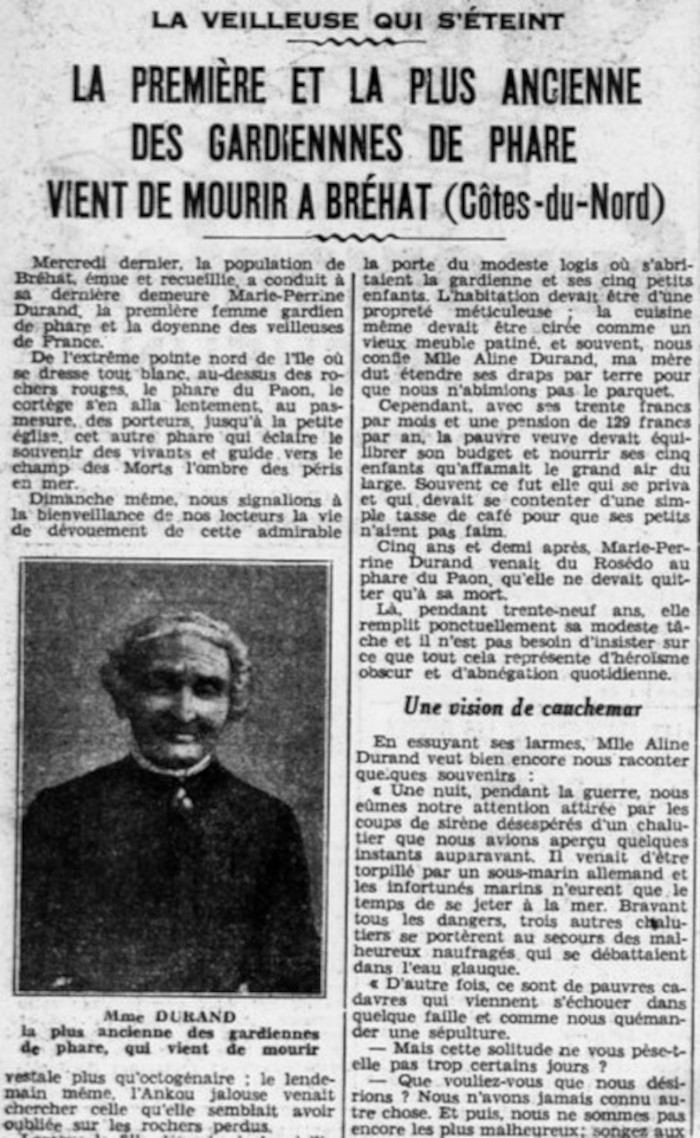
The very first woman to be appointed, three years before the publication of the new regulations in 1889, was Marie-Perrine Durand. The widow of a keeper who died in service, she was made responsible for lighting the Rosédo lighthouse on the Isle of Bréhat in 1886. She was employed under a contract renewed annually, which left her in an insecure employment position, until 1889.
The second female keeper, Marie-Perrine Messager, took over the Pontsuval lighthouse in Finistère on 8 December 1889, following the death of her husband. She had already been assisting him and knew perfectly how to operate it. She was appointed as keeper without being registered officially, and remained in post until 1910, when, at the age of 76, she was no longer physically able to carry out her duties. Her daughter, Joséphine Perrot, then took her place. She too was married to a lighthouse keeper and she followed him to the Kermorvan lighthouse a few years later.
This couples-based arrangement often led to women working as assistants in the service, as was undoubtedly the case for the first time in history at the Lost-Pic lighthouse in the Côtes-du-Nord, which was first lit in August 1894. A year later, at the Moutons lighthouse in the Glénan, the head lighthouse keeper Donnart had just become eligible for retirement in February 1895, and the Chief Engineer therefore proposed that Henri-Noël Colin and his wife be appointed to the island. “In such circumstances, we thought it might be possible to reduce the number of staff without compromising the lighthouse service […]. By replacing one of the keepers with a contracted worker paid 360 francs a year, we would save 440 francs per year. This solution has already been successfully implemented at several offshore lighthouses. It has also worked at Lost-Pic near Paimpol.”The second lighthouse-keeper role was therefore removed in 1895 and replaced by the unregistered lighthouse keeper, Marie-Catherine Colin (née Goyat), the wife of Henri-Noël Colin. Exhausted by the work, she had to leave the island to receive care inland, and her daughter Joséphine then took her place. In 1900, Joséphine resigned and was replaced by another woman, Jeanne-Marie Larsonneur, who was in fact the second daughter of Henri and Marie Colin.
This way of operating became the norm throughout France’s maritime departments whenever the opportunity presented itself. Thus, Martien Bontonnou was appointed in Finistère in 1902 and ended his career at the Audierne lighthouses. He qualified for retirement in January 1930 but died just a few weeks before, on 9 December 1929. His widow and children quickly requested assistance to ensure the survival of their family, and the engineer decided to appoint the mother and eldest daughter, who had already been responsible for lighting the lamp and keeping watch for many months, since Martien had been too ill to carry out his duties.
A Long Wait for Official Status
The lighthouse service systematically appointed married couples to replace registered keepers who were assigned to a different lighthouse, left the service, or retired. In this way, it was able to save an entire salary. After the departure of Mr Gourvil in 1909 from Île Noire in the Bay of Morlaix, the engineer proposed the appointment of the Scornet family, about whom he said, “We have heard very good things.” He added that Mrs Scornet was the daughter of the current keeper and was already well acquainted with how the service operated.
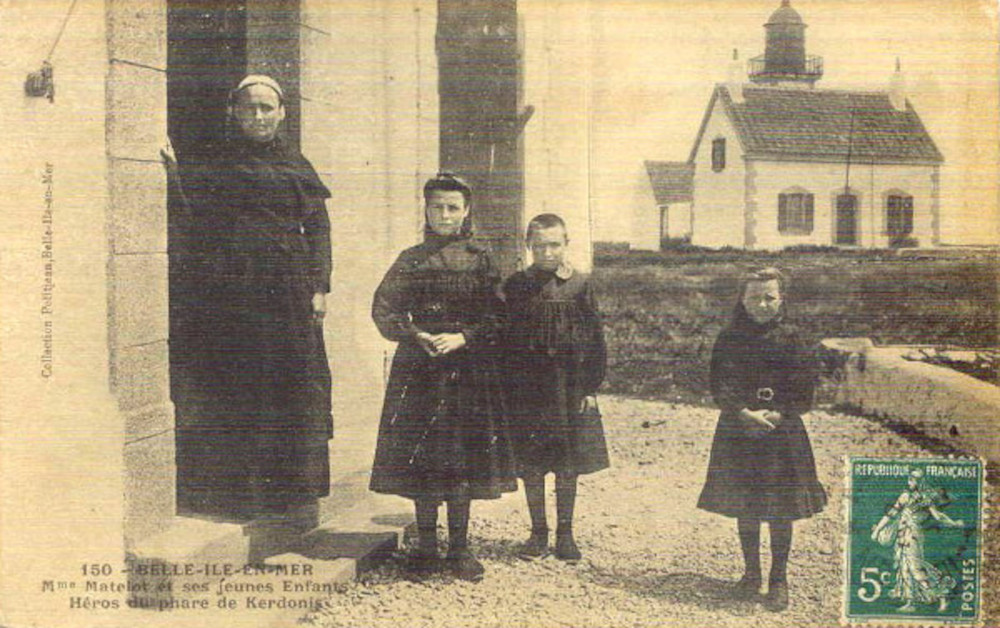
A tragic story confirmed just a few years later just how reliable the women’s service was. On Belle-Île, Mr and Mrs Matelot were in charge of the Kerdonis lighthouse. On 18 April 1911, the husband, Alexandre-Désiré, died before his duties were due to begin that evening. With the help of her children, the brave widow managed to keep the five red lamps flashing every 25 seconds, and these remained perfectly visible on the horizon.
On 31 October 1983, Gisèle Halimi, then MP for Isère, drew the attention of the Secretary of State in charge of maritime operations to the situation of these women under the Maritime Labour Code. Their official status was requested and granted the following year.
From 1984, women were permitted to apply for a degree in electromechanics. There were two: Françoise André was appointed lighthouse electromechanic in 1984 and assigned to the DECCA station in Aurillac, then to Lézardrieux. She was only later appointed to a sea lighthouse in January 2001, at Sept-Îles. At the time of writing, Sylvie Chalumeau-Brousse and Françoise André are the first and only female certified electromechanics in France.
According to the lighthouse keepers register currently being compiled by the National Centre for Lighthouses, 5,800 names are listed, of which 550 are assistant keepers, equivalent to one-tenth of the workforce (but it should be remembered that until 1886 none were officially recorded). Although these women were largely not taken into account by the administrative services, it is important to underline the high rate of feminisation within the profession. These percentages are consistently higher than in sectors traditionally considered reserved for women, such as teaching, social work, or postal and telecommunications services. However, even here, women remained confined to subordinate roles, serving as exploitable assistants with no job security or pension, and all while receiving significantly lower salaries.
Translated by Tilly O'Neill
