On 3rd May 1900, Dr Léon Azoulay addressed the members of the Paris Anthropology Society, outlining the potential applications of phonography across a wide range of fields including linguistics, language learning, anthropology, industry, meteorology, medicine, and the arts. He argued that phonography had the capacity to transform these sectors, while observing that its scientific potential remained largely unrecognised. As he remarked, “Right now we use it for amusement. This is the fate of every instrument when it is first developed. For the most part, we remain children, even savages, in its presence: we are either frightened of it or we play with it. Only with time, once we have become accustomed to it, do we become civilised in relation to it, understand its theoretical and practical scope, and employ it in the widest possible range of applications.”
One month later, addressing the same audience, Azoulay appealed for the Society’s support in establishing a phonographic museum of the world’s languages. His idea was to take advantage of the 1900 Paris Universal Exhibition, whose millions of visitors brought speakers of languages from every continent to the French capital. Azoulay explained that all that was needed was to take a phonograph to each of the national pavilions, and collect samples of the languages of all the different nations present.
A Noah's Ark of the World's Languages
The Paris Anthropology Society agreed to finance the purchase of the necessary equipment (phonograph, phonograms, recording sheets). Over a period of more than five months, Azoulay visited the national pavilions of the Universal Exposition, and assembled a collection “of more than 400 cylinder recordings: narratives, stories, conversations, phonetic samples, songs, and music representing more than 74 official languages, as well as numerous dialects and patois from regions across the world.”
For Azoulay, this extensive collection would enable scholars to “discover the laws governing the evolution of pronunciation, towards which ideal, one might say, our languages are moving”, as well as “acquire precise information on the origins, heritage and diversity of modern languages.” He believed that documenting languages from around the world was particularly urgent because many were destined to disappear. Influenced by a form of linguistic Darwinism, Azoulay regarded the advance of modernity as inevitable and believed that many vernacular languages would eventually fall into oblivion. His conviction in the universal progress of civilisation was reflected in his hierarchical classification of human societies as “civilised”, “half-civilised”, or “uncivilised” (“savage”), and in his references to “inferior races” including, for example, the peoples of Papua New Guinea.
The Breton Village at the Universal Exposition
On 15th July 1900, Azoulay recorded what is believed to be the earliest surviving sound recording of Gallo from a woman in her thirties from Loire-Inférieure (now Loire-Atlantique). A few days later, on 20th July, he brought his phonograph to the Breton Village at the Universal Exposition for the first time. Situated between rue Saint-Dominique and avenue de La Bourdonnais, the village reproduced some of Brittany's most emblematic and ‘authentic’ buildings and monuments. Among replicas of a menhir from Loire-Inférieure, the Pencran cemetery gateway, a thatched cottage, a timber-framed house from rue Noble in Morlaix, and the edicule of Saint-Jean-du-Doigt, Azoulay encountered both the Breton intellectual elite and the wider Breton community residing in the French capital.
Paul Sébillot, assistant director of the Breton Village and brother-in-law of Yves Guyot, president of the Anthropology Society, was expecting Azoulay. Over the course of several days, Azoulay used his phonograph to record the voices of Sébastien and Aline Le Bot, Pierre Laurent, Marie-Joseph Rio, Jean-Mathurin Pocard, and Corentin Pichavant. These recordings made between 20th and 29th July 1900 are the oldest known recordings of the Breton language. Azoulay also used it as an opportunity to produce the earliest known instrumental recordings of Breton music by recording the talabarder Alain Pierre Guéguen, known as Lanig Pen-ar-Pont.
Two years later, in December 1902, Azoulay once again recorded Breton speakers. He documented several versions of a Breton song performed by a woman from Plouider and also made two recordings in French: one with an anonymous singer from Plédéliac and the other with Yves Guyot. During this period, internal conflicts emerged within the Anthropology Society, leading to the closure of the phonographic museum. Despite this setback, Azoulay remained in contact with and advised those involved in similar initiatives that were beginning to develop across Europe at the beginning of the 1900s.
In France, it was not until a decade later that a new and ambitious initiative to document oral traditions was established. In 1911, the Archives de la Parole opened at the Sorbonne thanks to an initiative organised by linguist Ferdinand Brunot. Azoulay, still embittered by the failure of his phonographic museum, once again addressed the members of the Anthropology Society and criticised what he perceived as the institution’s lack of foresight. Referring to the creation of the Archives de la Parole, he declared: “Doubtless you feel right now, since the opening of the Archives de la Parole, the efforts the Anthropology Society had to make, not only to preserve the prestige which gave it its enviable position in the history of scientific phonography - a prestige which I alone, I am not afraid to say, have sought to maintain through both my work and my advocacy - but also to become the centre of studies that Mr Yves Guyot wished it to be in 1901, and which would have brought it even greater distinction.”
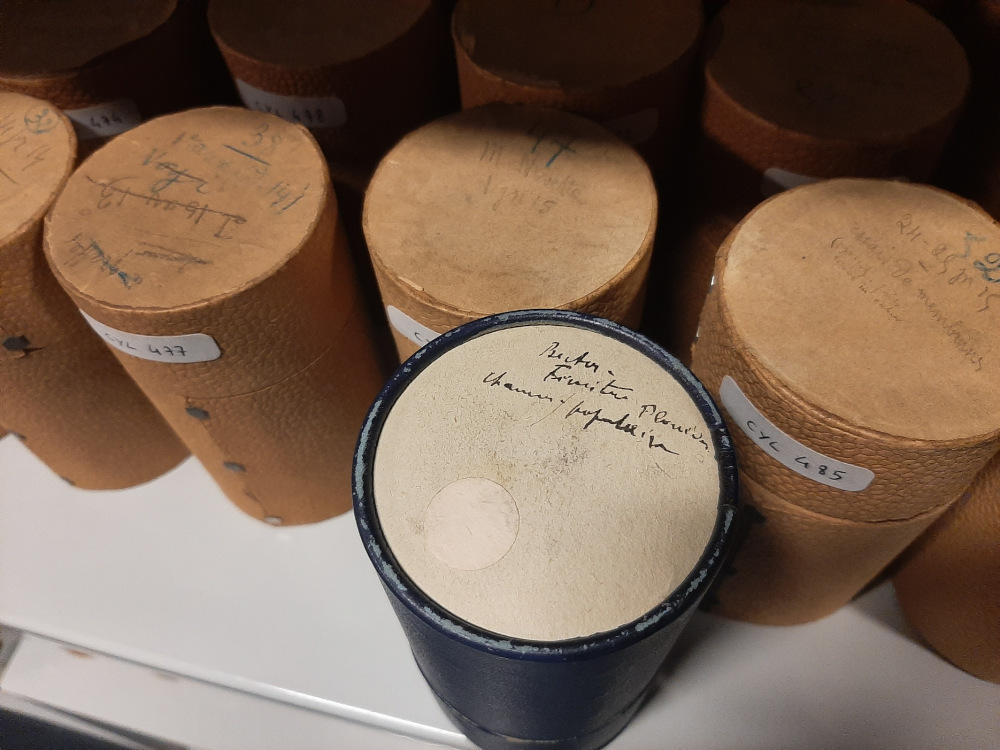
In the shadow of the Archives de la Parole, Azoulay’s phonographic museum cylinders gradually fell into obscurity and neglect, becoming almost entirely absent from the history of phonography. These recordings of voices from a bygone era were transferred to Paris’ Musée de l’homme in 1943 before eventually being deposited at the Centre de recherche en ethnomusicologie (CREM) at Paris Nanterre University, which also holds Azoulay’s documentation records and music manuscripts. CREM has since made all the recordings from the 1900 Universal Exposition available online, while Azoulay’s original wax cylinders are now preserved at the French National Library in a dedicated room designed for the conservation of these precious wax objects.
List of Breton phonograms recorded by Léon Azoulay:
Sébastien Le Bot, Ploudiry, Léon
Ar c’hleuz alaouret hac an tour dantelezet – 20 July – 02:14.45
Keuzial d’am yaouankiz – 20 July? – (broken)
Aline Le Bot, Ploudiry, Léon
Ar mab prodig, version éditée par Leon Alfred Llewellyn Jenkins – 20 July? – 02:55.07
Corentin Pichavant, Pont-l’Abbé, Bigouden – 04:33:62
Yann ha Marjan – 24 July – 1:38.53
Ar mab prodig version de Pont-L’Abbé – 24 July – 02:55.09
Jeanne Le Gouil, Quimper, Cornouaille – 06:49:44
An dezertour – 20 July – 2:44.05
An den desolet gant e wreg – 20 July – 01:50.41
O tont d’ar gêr eus Pont-’n-Abad – 20 July – 02:09.98
Marie-Joseph Rio, Pluvigner Vannes
Disul vitin a pa sauèn - 26 July – 02:49.53
Jean-Mathurin Pocard, Erdeven, Vannes – 06:22:11
A p’em behé ur galand – 26 July – 02:12.45
Guéharall a pa oen yeuank – 26 July – 02:03.28
Imen e kavein-me ur pasajer – 26 July – 2:06.38
Budjaledjeou – 26 July – (broken)
Pierre Laurent, Belz, Gwened – 05:52:44
Sonenn en deinserion – 24 July? - 1:26 (on the same cylinder as Pen da d’ein mé)
Pen da d’ein mé – 24 July? - 1:25 (on the same cylinder as Sonenn en deinserion)
Ar mab prodig version de Belz – 24 July– 02 :53.55
Alain-Pierre Gueguen, talabarder Pont-l’Abbé
Quatre airs de bombarde – 21 July – 02:41
La Tourterelle – 21 July – (broken)
Female singer from Plouider 1902 – 09:05
Disul vintin mintin mat – 21 December 1902 – 02:32
Soudard yaouank Kommanna (three cylindrs) – 21 December 1902 – 2:36 / 2:21 / 1:36
Translated by Tilly O'Neill
