
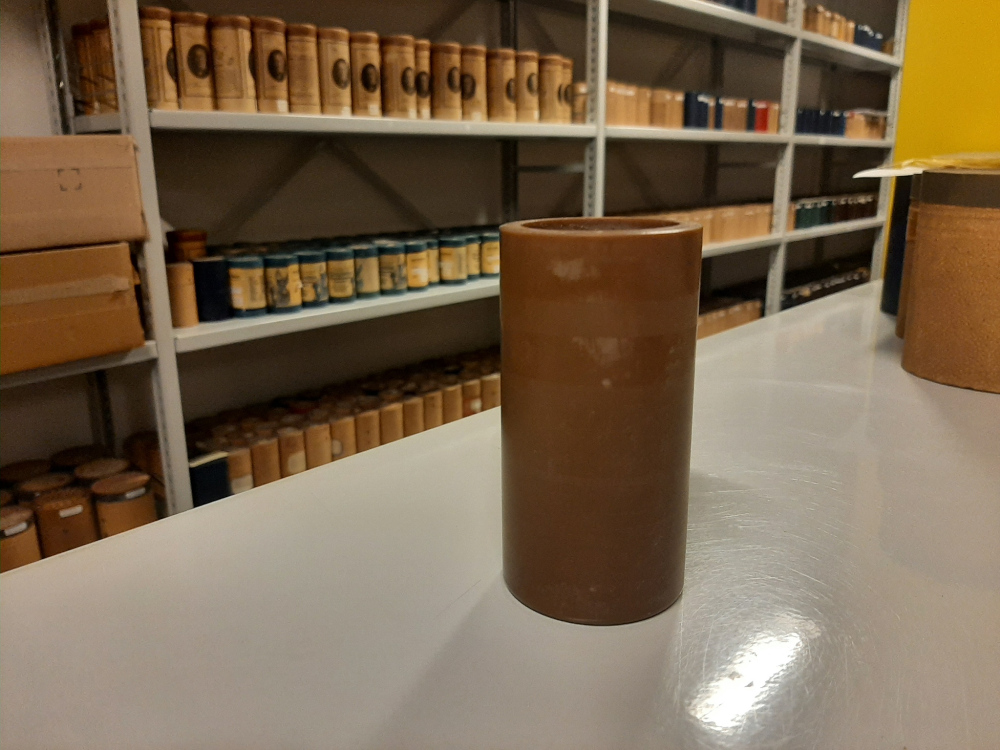
On 15th July 1900, a woman positioned herself in front of the horn of Léon Azoulay’s phonograph and recited a series of sentences and vocabulary items: “T’as mal à l’oraille, ta ? J’ai tombé ma. Je l’ai lavé avé de l’iao.” These words, recorded onto wax cylinders, constitute the oldest known oral example of the language of Upper Brittany. The recording provides valuable linguistic information about the evolution of the Gallo language, and it is all the more precious given that an accompanying transcript also exists.
Léon Azoulay recorded only one wax cylinder featuring this woman. Her exact identity remains unknown, but according to documentation label no. 159 for phonogram no. 60, the speaker came from the rural district of Belligné (Loire-Atlantique), as did her parents. Aged 34, she was able to read and write, and had been living in Paris for eight years, where she worked as a maid. This recording is particularly remarkable because the majority of Azoulay’s documentation consists of recordings in foreign languages. Recordings of French languages other than Breton and Basque are rare. Yet from the very beginning of the project, Azoulay had clearly expressed his desire to document and record all the different French dialects and patois, as he stated himself in spring 1900.
In 1901, Léon Azoulay explained to the members of the Anthropological Society why there were so few French phonograms in his collection. According to him, the people he approached were reluctant to have their voices preserved in a museum. Above all, it was becoming increasingly difficult, at least in Paris, to find people who could still speak the patois they had grown up with fluently. He therefore stressed the urgency of phonographic documentation of French dialects and patois, along with their songs, stories and other forms of oral expression, before they disappeared for good.
Azoulay believed that the extinction of these spoken languages was inevitable and not far off. As he explained: “The dominant use of French in administration, schools, the army and expanding social interactions means that today, even in small villages, all these regional characteristics are disappearing. The different patois are becoming increasingly standardised, with French words adopting the intonation and suffixes of patois, until the patois itself eventually becomes French. Yet we must not forget that these patois are historically the sister languages and rivals of French. These less fortunate sisters are gradually extinguished by the political, economic and social dominance of the communities that have always spoken and continue to speak French. This is why it is of vital importance that their literary, oral and musical heritage be recorded.”
Translated by Tilly O'Neill
